- World Population Review Newsletter
- Posts
- Canada and the World Face a Vanishing Student Crisis
Canada and the World Face a Vanishing Student Crisis
How collapsing birth rates and trust are reshaping public education worldwide.

Philip Saparov
December 16, 2025
In partnership with

Welcome, curious mind.
The future of education is changing — fast. Around the world, public schools are seeing fewer children walk through their doors. But this isn’t just a baby bust.
Parents are leaving — driven by safety concerns, falling trust in institutions, and a growing appetite for private and alternative schooling.
In this issue, we break down which countries are seeing the biggest shifts — and what it means for families, policymakers, and anyone planning where to live, invest, or raise a child.
Let’s dive in.
Smarter Policy Begins With Smarter Data
See why thousands of readers trust The Audit for fact-based analysis.

Canadian policy affects your taxes, your freedoms, your economy — and your future. The Audit breaks it down without spin, using real numbers, real datasets, and real accountability.
If you’ve ever wondered how decisions are actually made in Canada, this is where to start. Join The Audit.
Canada offers one of the most striking paradoxes in the developed world: a population that’s expanding while its public school enrollment contracts. Immigration has fueled national growth by 16% since 2014, yet the number of younger children continues to fall — and public schools are feeling it first.
In Ontario, Grade 1 classrooms are 29% smaller than Grade 12 cohorts. Unless the trend reverses, today’s six-year-olds will graduate into a system nearly half the size it was in 2015. At the same time, private school enrollment has jumped nearly 25% in under two decades, and homeschooling — once a niche choice — has become a durable post-pandemic alternative.
Why the dramatic shift? Many parents cite safety concerns, declining academic performance, and frustration with bureaucracy. Others simply want more individualized attention than large public systems can provide.
Unexpected detail: Canada has 14% fewer five-year-olds than seventeen-year-olds — a demographic imbalance now baked into the country’s long-term educational outlook.

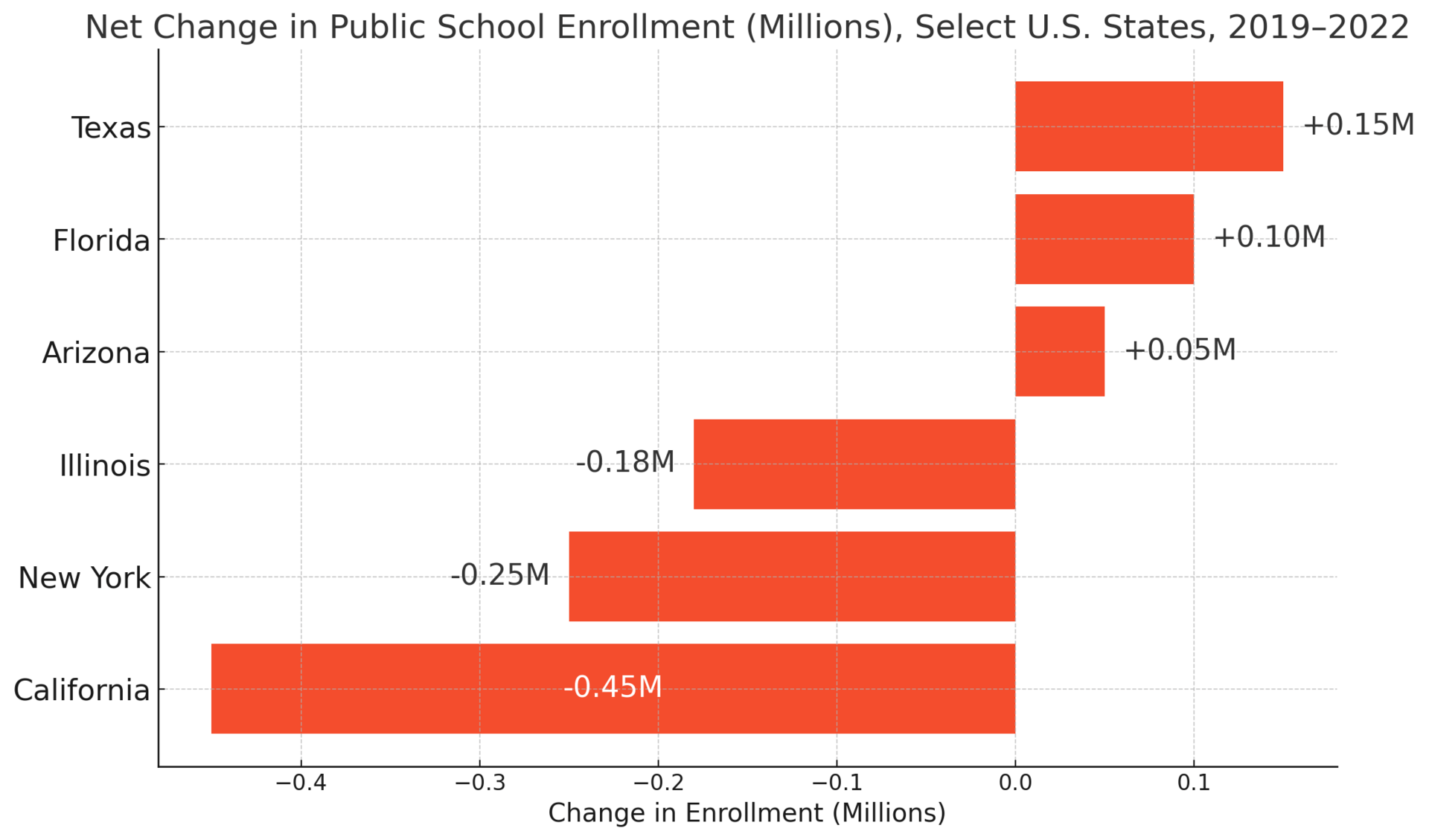
Unlike Canada’s unified story, the U.S. presents a patchwork of educational realities. Some states face rapidly shrinking student populations, while others—mainly in the South and Mountain West—continue to grow. But even in expanding states, public school enrollment isn’t keeping pace with population growth.
Families are increasingly turning to charter schools, microschools, hybrids, and full-time homeschooling. During the pandemic, U.S. homeschooling rates doubled, and the decline in public enrollment has persisted long after reopening. Meanwhile, birth rates hit a 40-year low, meaning smaller kindergarten classes for years to come.
For retirees, investors, and parents alike, these shifts carry real implications: state funding formulas, teacher shortages, and local tax structures will all be shaped by enrollment swings — up or down.
Little-known fact: Between 2019 and 2022, public school enrollment nationwide fell by over 1.3 million students, the largest drop in modern U.S. history.
South Korea’s public education system is admired for its rigor but is now grappling with the fastest demographic contraction among OECD countries. With fertility hovering near 0.7, classrooms are emptying out faster than the system can adapt.
As competition intensifies, many families shift toward private academies (“hagwons”), which have long dominated the Korean learning landscape. This dual system — elite private tutoring alongside struggling public schools — has pushed parents to delay or forgo having children due to the high cost of education.
The government has launched incentives ranging from childcare subsidies to housing support, but so far, none have reversed the decline.
Striking statistic: Some Korean elementary schools are closing after enrolling fewer than 10 new students in an entire year.


Canada’s public schools are losing students fast — and the new data is startling. See what’s driving the decline and why it matters.
Japan has faced a shrinking student population for decades, with some rural schools enrolling only a handful of children. In response, communities have tried creative solutions: combining grade levels, repurposing empty buildings, and even recruiting international families to revitalize districts.
Despite these challenges, trust in public education remains high — a key difference from Western nations. Still, the math is unavoidable: with fertility at 1.3, the country simply doesn’t have the children to maintain its former school footprint.
This has led to consolidation, school mergers, and growing interest in alternative pathways, including international schools for globally minded families.
Unexpected detail: Japan now has over 10,000 “empty schools” — buildings closed due to low enrollment — many of which have been converted into libraries, offices, and community centers.

Italy’s demographic decline is the steepest in Europe, with one of the world’s oldest median ages and fertility stuck near 1.2. Public schools, especially in rural regions, are losing students at a pace that challenges long-term planning.
Simultaneously, private and parochial schools have held steady or grown modestly, as parents seek stability amid concerns about curriculum changes, staffing shortages, and uneven academic performance.
To cope, some Italian municipalities offer cash incentives for families who remain in shrinking towns — but these efforts struggle against broader economic uncertainty.
Compelling note: Some Italian villages now have more teachers than students enrolled in their local primary schools.

Australia’s fertility decline mirrors global patterns, yet the more surprising trend is the shift away from public schools despite strong national performance metrics. Independent and Catholic schools have expanded enrollment for nearly two decades, especially in major cities.
Parents cite better discipline, safer environments, and clearer academic expectations. Public systems, meanwhile, face growing class sizes, teacher shortages, and contentious debates over assessment standards — all of which erode trust.
For migrants — a key driver of Australia’s population growth — private schooling is often seen as a fast track to integration and opportunity, accelerating the divide.
Interesting insight: In some Australian suburbs, more than 50% of secondary students now attend non-government schools.

Across the world, two forces are reshaping public education:
(1) population decline, especially in aging nations, and
(2) a surge in educational alternatives.
Countries with low fertility — from Spain and Portugal to Singapore and China — are already confronting the coming enrollment cliff. Even nations with stable populations see parents opting out of public systems due to concerns about outcomes, safety, or educational philosophy.
As families diversify their approach to learning, public schools face a future in which they must compete more aggressively for trust — and for students.
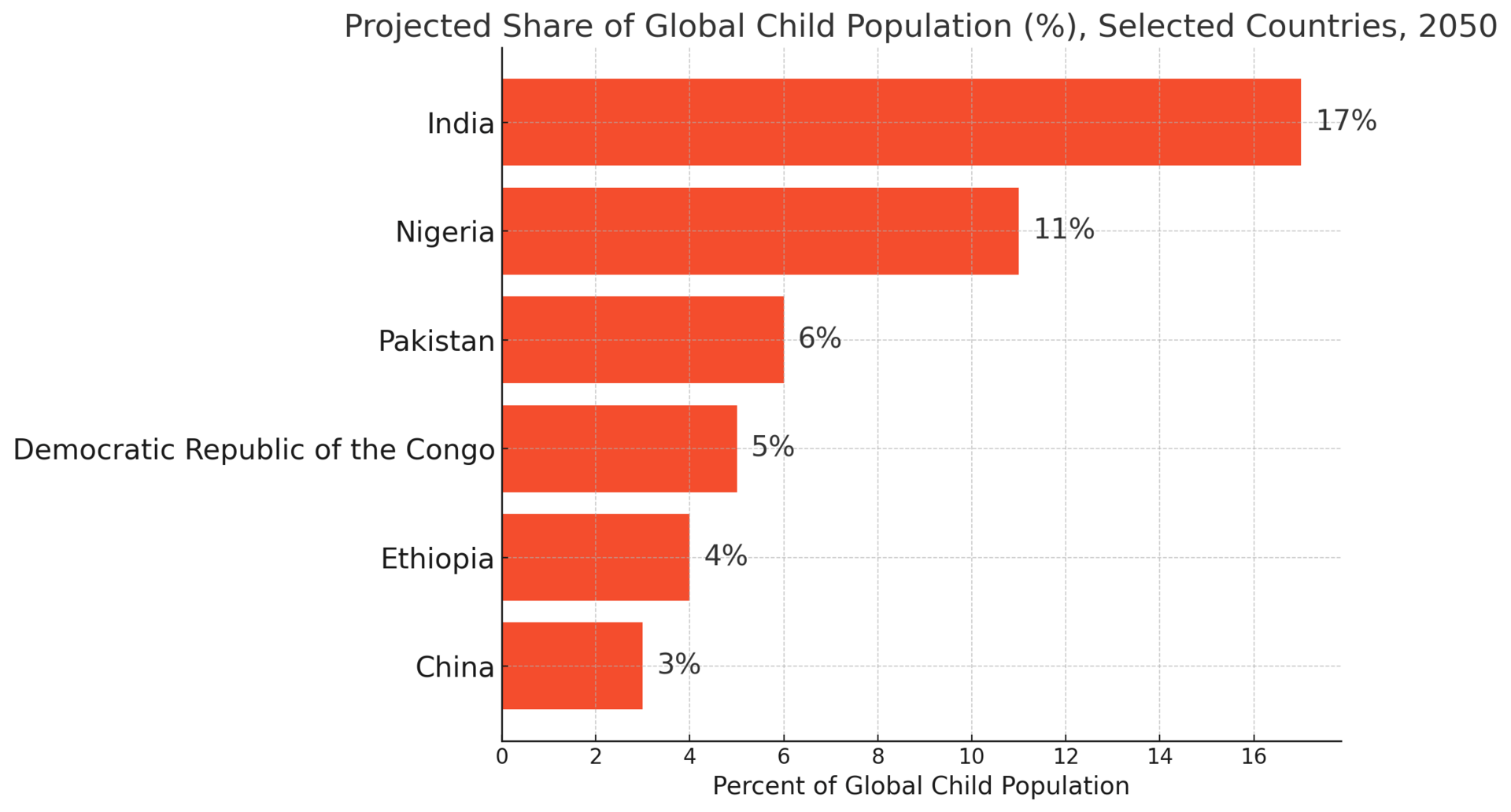
Fascinating projection: By 2050, more than two-thirds of the world’s children will live in just 10 countries, dramatically shifting where educational demand — and opportunity — will concentrate.
Canada’s biggest challenges — debt, demographics, representation, governance — are all measurable. The Audit turns complex public data into clear, sharp insights you won’t find in traditional media.
Backed by subscribers who value honesty, transparency, and evidence-based thinking. Explore The Audit →
The vanishing public school student isn’t just about demographics. It’s a signal — pointing to deeper shifts in trust, values, and how the next generation will learn.
For families, investors, and decision-makers, these trends aren’t optional to understand. They shape where to live, where to allocate resources, and what kind of future we’re building.
We’ll keep watching the numbers — so you can stay ahead of the story.
Warm regards,
Shane Fulmer
Founder, WorldPopulationReview.com
P.S. Want to sponsor this newsletter? Reach 140,000+ global-minded readers — click here!