- World Population Review Newsletter
- Posts
- Is This the End of the Weekend as We Know It?
Is This the End of the Weekend as We Know It?
How work is gradually invading rest and leisure across the globe.

Philip Saparov
May 14, 2026
In partnership with

Greetings, curious mind of modern life!
The weekend used to mean rest. Now, for millions of people, it means catching up on emails, side hustles, and unfinished work. Across the world, the line between work and personal life is fading—but not everywhere equally.
This week, we explore the countries where weekends are disappearing, the places fighting to protect downtime, and why the future of rest may shape everything from health to happiness to economic success.
Let’s dive in.
The Only Christian Precious Metals Firm in America.

Most gold dealers are in the business of moving inventory. We're in the business of protecting legacies and our faith shapes everything about how we do it.
True Gold Republic is the only Christian-based precious metals firm in the country. That means no fear tactics, no pressure, and a team that holds itself to a higher standard long after the sale. Our founder left London's metals industry specifically to restore dignity to a space that had lost it.
Zero setup fees. Zero-fee buyback. A written best-price guarantee. Your own dedicated account rep.
Claim your free 2026 Precious Metals Kit. No cost, no obligation and discover the tax-advantaged move most advisors never mention.
For decades, South Korea has been famous for its relentless work culture. Long office hours, after-work dinners, and fierce competition helped transform the country into an economic powerhouse—but at a growing human cost.
Today, South Koreans work significantly longer hours than most developed nations. Sleep deprivation, stress-related illness, and record-low birth rates have forced the government to rethink the model entirely.
🇰🇷 In Seoul, “gwarosa”—death from overwork—is now a recognized social issue.
🇰🇷 The government capped the workweek at 52 hours in 2018, hoping to restore some balance to family life and mental health.
🇰🇷 Yet many younger workers say work still follows them home digitally, especially in finance, tech, and education sectors.
The deeper issue may not be hours alone—it’s expectation. In many industries, employees still feel pressure to remain reachable at all times.
A striking detail: South Korea’s fertility rate recently fell below 0.8 children per woman—the lowest recorded nationally anywhere in the world.
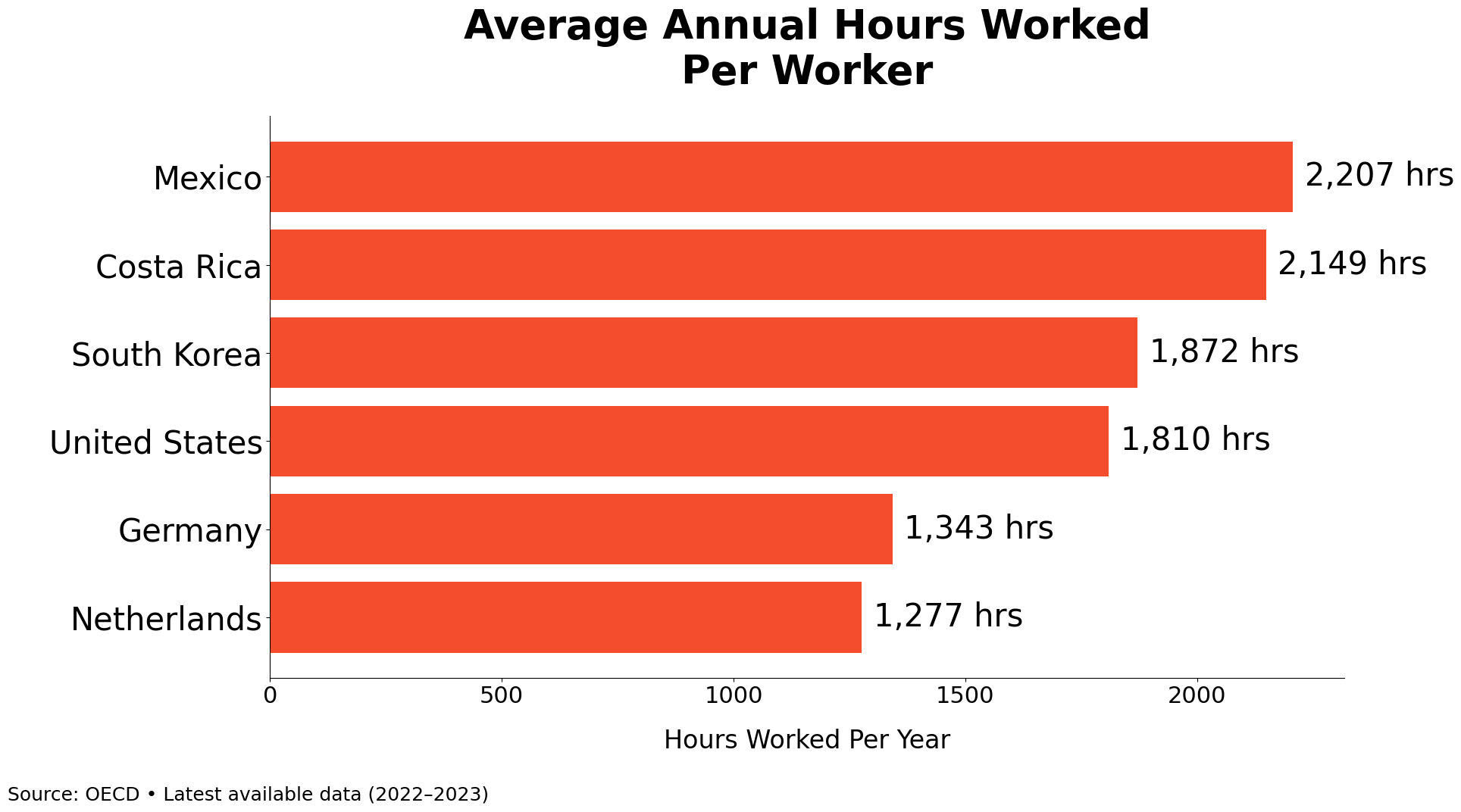
Few countries defend leisure quite like France. While much of the world normalized constant connectivity, France took a radically different path: protecting personal time by law.
🇫🇷 Since 2017, large French companies have been required to establish rules limiting after-hours work communication.
🇫🇷 Employees in some industries are discouraged—or outright forbidden—from answering emails during evenings and weekends.
🇫🇷 The country also maintains one of the shortest average workweeks among major economies while preserving strong productivity per hour worked.
Critics once argued this would weaken competitiveness. Instead, France remains one of the world’s largest economies and a global leader in luxury goods, aerospace, energy, and tourism.
What France understands is simple but profound: rest is not the opposite of productivity. In many cases, it sustains it.
An overlooked fact: French workers average roughly five weeks of paid vacation annually—not including public holidays—yet labor productivity per hour consistently ranks among the world’s highest.

Japan’s relationship with work has long fascinated the world. Precision, discipline, and loyalty helped fuel decades of economic growth—but also created one of the most intense workplace cultures on Earth.
🇯🇵 The word “karoshi,” meaning death by overwork, entered the global vocabulary decades ago.
🇯🇵 Some employees historically worked so many overtime hours that sleeping at the office became normalized.
🇯🇵 Today, however, Japan is beginning a slow cultural correction.
Major firms are experimenting with four-day workweeks, flexible schedules, and mandatory vacation policies. Microsoft Japan famously reported a productivity jump of nearly 40% during one shortened-workweek experiment.
Younger generations appear less willing to sacrifice health and family for corporate loyalty. Many now prioritize flexibility over lifetime employment guarantees.
One revealing trend: Japan now has entire “sleep cafés” where exhausted workers can rent quiet spaces to nap during the day—a modern business model born directly from chronic national fatigue.

Unlocking a Priority for 76% of Millennials

76% of millennials now prioritize experiences over things. That's the gap Tipsy Putt is stepping in to fill. The San Francisco grand opening is projected for 2027. You can invest in their new location.
This is a paid advertisement for Tipsy Putt Regulation CF offering. Please read the offering circular at https://invest.tipsyputt.com/
No major economy has embraced hustle culture quite like the United States. In many industries, availability itself has become a form of competition.
Emails arrive late at night. Gig work fills spare hours. Side businesses operate alongside full-time jobs. And for millions of Americans, weekends increasingly feel like administrative catch-up time rather than recovery.
🇺🇸 Remote work accelerated this shift dramatically after 2020.
🇺🇸 Professionals now report working longer total hours from home than they did in traditional offices.
🇺🇸 Meanwhile, the rise of freelance platforms has created a 24-hour labor market where workers can earn—but also work—continuously.
Yet the U.S. model has undeniable strengths too. High flexibility allows ambitious individuals to scale income rapidly, build businesses, and relocate more freely than in many rigid labor systems.
The tradeoff is sustainability.
A telling statistic: the U.S. remains the only wealthy industrialized nation without federally mandated paid vacation time. Roughly one in four American workers receives no paid vacation at all.

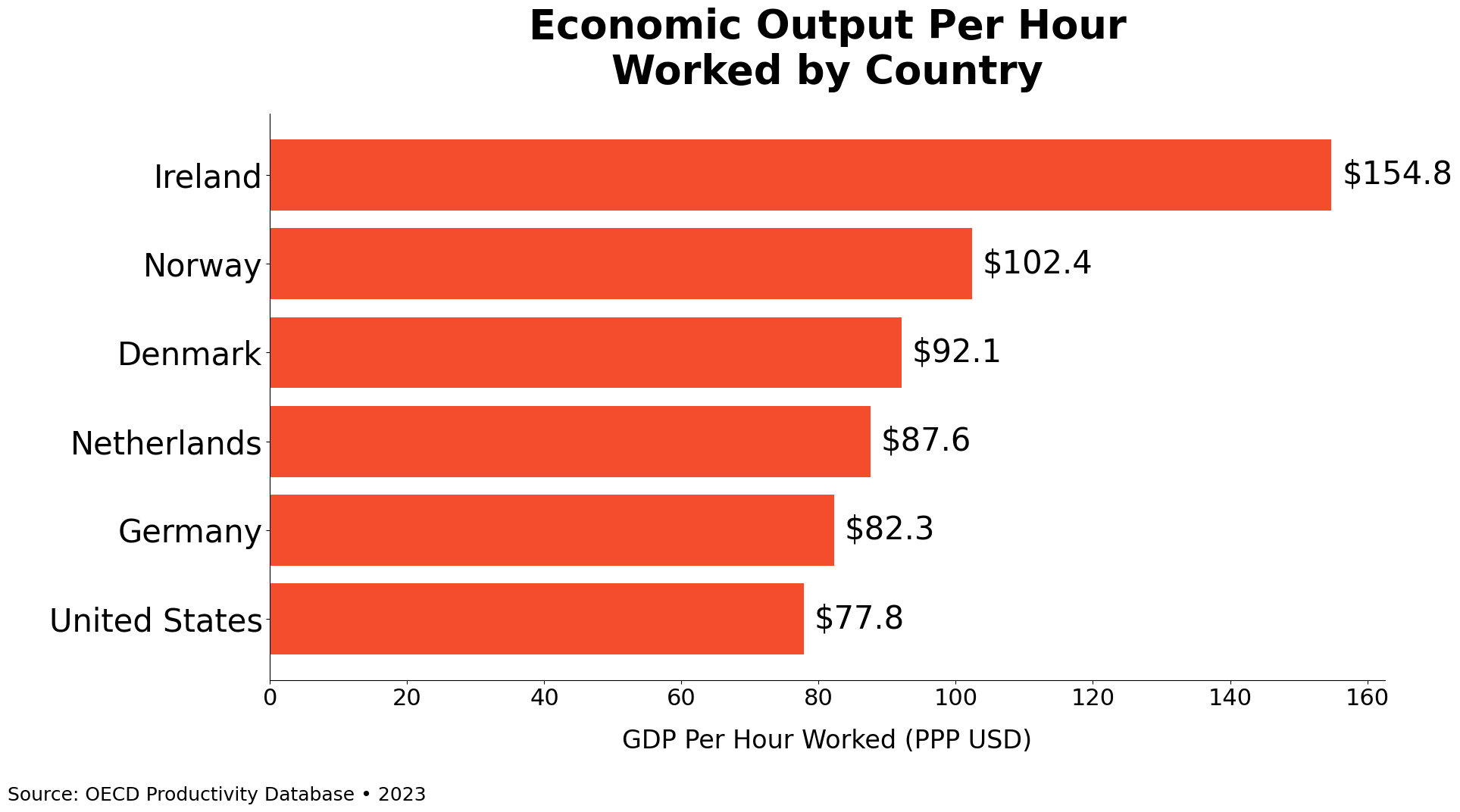
If long hours created the strongest economies, Denmark, Norway, and the Netherlands should be struggling. Instead, many Northern European countries consistently rank among the world’s richest, happiest, and healthiest societies—despite shorter working hours.
🇩🇰 Denmark prioritizes flexibility and family time, with many offices emptying by late afternoon.
🇳🇱 In the Netherlands, part-time work is widely accepted—even among professionals and managers.
🇳🇴 Norway combines high wages with generous parental leave and vacation protections.
What’s remarkable is that these nations remain highly productive globally. Their approach suggests something counterintuitive: beyond a certain point, more work hours may produce diminishing returns.
These countries also score exceptionally well in life satisfaction, trust, and social stability—factors increasingly important for retirees, families, and remote workers evaluating relocation options.
One fascinating contrast: Dutch employees average hundreds fewer work hours annually than Americans, yet the Netherlands remains one of the world’s largest agricultural exporters by value.
China’s rise into an economic superpower came with an unofficial slogan in parts of the tech industry: “996”—working 9 a.m. to 9 p.m., six days a week.
For years, many entrepreneurs celebrated the model as necessary for national competitiveness and rapid innovation.
🇨🇳 Tech giants expanded at extraordinary speed under this culture.
🇨🇳 Young workers, however, increasingly pushed back against exhaustion and limited personal freedom.
🇨🇳 Online movements promoting “tang ping,” or “lying flat,” emerged as quiet acts of resistance against nonstop pressure.
China now faces an unusual tension: maintaining rapid growth while addressing burnout, youth unemployment, and declining birth rates.
Interestingly, some Chinese companies are beginning to experiment with more balanced schedules—not purely for worker happiness, but because exhaustion reduces creativity and long-term efficiency.
China’s population has already begun shrinking, and many economists believe work intensity is becoming part of the broader family-formation crisis.
One revealing detail: in surveys of younger urban Chinese workers, “having time for life” increasingly ranks above salary growth when choosing employers.

The weekend itself may be entering a new phase—not disappearing entirely, but fragmenting.
Instead of two universally protected days, the future may revolve around personalized flexibility. Some workers will trade weekends for remote freedom. Others may work shorter weeks but remain digitally connected at all times.
Several major trends are already emerging:
🌍 Four-day workweek trials are expanding across Europe, Australia, and parts of Latin America.
🤖 AI and automation may eventually reduce repetitive work hours—but could also intensify competition in high-skill industries.
🏡 Remote work is enabling millions to relocate based on lifestyle rather than office proximity.
Countries that successfully balance productivity with recovery may gain unexpected advantages in health, family formation, and talent retention.
A remarkable projection: economists estimate burnout and disengagement already cost the global economy trillions of dollars annually through lost productivity, healthcare costs, and worker turnover.

The weekend once separated work from life. Now, in many places, that line is fading fast.
As countries rethink the balance between productivity and rest, one thing is becoming clear: the future of work may depend on protecting time away from it.
Stay informed, stay observant, and keep exploring the forces reshaping modern life.
Warm regards,
Shane Fulmer
Founder, WorldPopulationReview.com
P.S. Want to sponsor this newsletter? Reach 138,000+ global-minded readers — click here!