- World Population Review Newsletter
- Posts
- Pollen Maps Are Changing—Here’s What It Means
Pollen Maps Are Changing—Here’s What It Means
Longer allergy seasons are reshaping health, lifestyle, and mobility.

Philip Saparov
December 13, 2025
In partnership with

What if your allergies aren’t getting worse — but the world is?
Across the globe, pollen seasons are starting earlier, lasting longer, and hitting harder. For millions, this isn’t just a seasonal sniffle — it’s a growing health challenge reshaping where we live, retire, and breathe easiest.
In this edition, we uncover the countries where allergy seasons are becoming unbearable — and where you might still find relief.
Let’s dive in.
Introducing the first AI-native CRM

Connect your email, and you’ll instantly get a CRM with enriched customer insights and a platform that grows with your business.
With AI at the core, Attio lets you:
Prospect and route leads with research agents
Get real-time insights during customer calls
Build powerful automations for your complex workflows
Join industry leaders like Granola, Taskrabbit, Flatfile and more.
In the United States, the allergy calendar is expanding — both in length and intensity. Climate change is driving warmer springs and later frosts, giving plants a longer window to release pollen.
According to the Asthma and Allergy Foundation of America, pollen seasons in U.S. cities have grown by 20 days on average since 1990. But in places like Reno, NV and Scranton, PA, that number is closer to 30–40 days.
Even worse: the air’s pollen concentration is increasing — meaning more allergens per breath.
Top U.S. cities for severe allergy sufferers include:
Wichita, KS: Often ranks #1 for pollen exposure and asthma-related ER visits.
Dallas, TX: With rapid urban growth and long ragweed seasons, it's a year-round hotspot.
Knoxville, TN: Known for high pollen diversity, causing layered allergic reactions.
🌿 Insight: The average pollen season in the U.S. now lasts more than 70% longer than it did 30 years ago — and it’s trending up.

Canada, long considered a refuge from extreme allergy seasons, is experiencing a shift. Warmer temperatures and urban tree choices are changing the pollen map.
In Toronto, allergy seasons have started 2–3 weeks earlier than historical averages. Prairie cities like Winnipeg and Calgary are seeing spikes in grass pollen, while Montreal’s tree pollen season is lengthening — a growing concern for aging residents.
Key factors:
Urban planners in the 20th century overplanted male trees, which release massive amounts of pollen.
Increased CO₂ levels are making plants like ragweed more potent and productive.
🌿 Did you know? One ragweed plant can release up to a billion pollen grains per season — and those grains are becoming more aggressive.

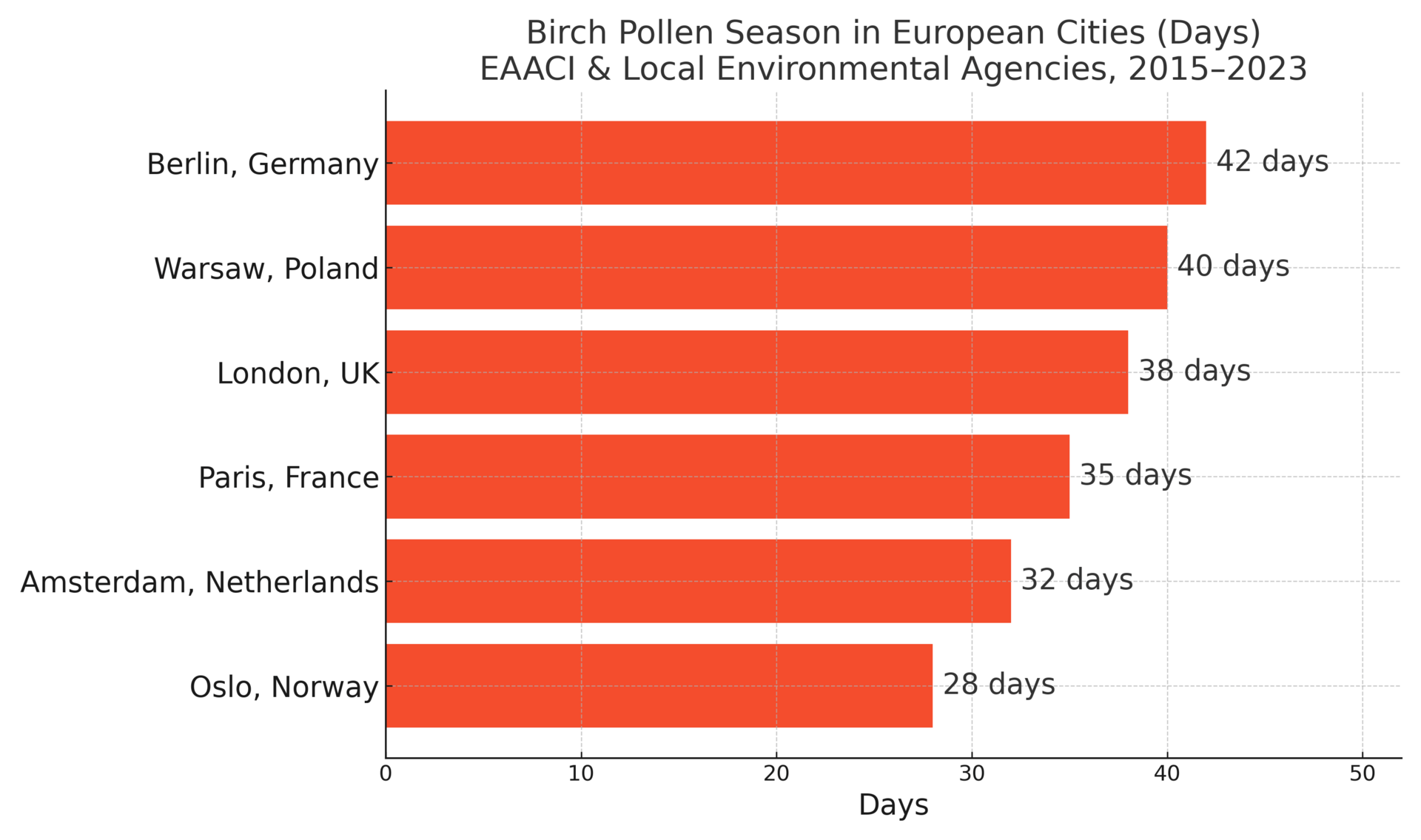
Europe is not immune. The continent is seeing a northward migration of allergens, with countries like Germany, the UK, and the Netherlands experiencing unfamiliar pollen patterns.
🔸 Berlin now reports birch pollen season lasting over 40 days, up from 25 two decades ago.
🔸 In London, oak and grass pollen are arriving earlier and overlapping — causing prolonged symptoms.
🔸 Northern France has seen ragweed, once rare, become a seasonal scourge.
Researchers link this to climate zones shifting — making southern plant species viable farther north.
🌿 Curious fact: Some European cities are considering “pollen zoning” — limiting certain allergenic species in new public green spaces.
If You Could Be Earlier Than 85% of the Market?

Most read the move after it runs. The top 250K start before the bell.
Elite Trade Club turns noise into a five-minute plan—what’s moving, why it matters, and the stocks to watch now. Miss it and you chase.
Catch it and you decide.
By joining, you’ll receive Elite Trade Club emails and select partner insights. See Privacy Policy.
Asia’s allergy problem is particularly sharp in places like Japan and South Korea, where government tree-planting decisions decades ago have backfired.
In Japan, vast cedar forests were planted post-WWII for timber. Today, these aging trees release staggering volumes of pollen. The result? “Pollinosis” affects over 40% of the Japanese population, especially in Tokyo and surrounding prefectures.
In South Korea, urbanization and invasive weeds like Japanese hop have created similar issues — particularly in Seoul, where allergy-related medical visits spike every spring.
🌿 Striking statistic: Tokyo experiences over 60 days of cedar pollen per year — nearly double what it was in the 1980s.

Australia’s “hay fever belt” — including Melbourne, Canberra, and Hobart — is seeing longer seasons and stronger allergic responses. The expansion of ryegrass and introduced weeds like plantain is making things worse.
Meanwhile, thunderstorm asthma — a dangerous weather-pollen combo — has emerged as a serious concern. The 2016 Melbourne event sent thousands to hospitals in a single night, triggered by sudden pollen bursts.
New Zealand, while less affected, is starting to report longer grass pollen seasons in Auckland and Wellington.
🌿 Did you know? Australia’s allergy rates are among the highest globally — nearly 1 in 5 adults reports hay fever symptoms.

Latin America doesn’t often top allergy lists — but change is underway.
Cities like Mexico City, São Paulo, and Buenos Aires are grappling with rising pollen levels linked to expanding urban forests, smog, and extreme weather. In particular:
Mexico City’s high altitude and pollution trap allergens, intensifying reactions.
Buenos Aires suffers from a long grass season, aggravated by poor air circulation.
Yet underdiagnosis remains a problem. Allergy care is often limited — meaning many sufferers endure symptoms without relief.
🌿 Hidden truth: In Mexico City, studies show nearly 40% of children experience allergic rhinitis — but fewer than 15% receive treatment.

If you’re thinking of relocating — or simply planning an extended trip — some places remain relatively allergy-free (for now). Cooler, ocean-influenced climates and low-pollen ecosystems offer reprieve.
Top contenders:
Reykjavik, Iceland: Sparse vegetation, clean air, and short growing seasons.
Honolulu, Hawaii: Coastal winds and limited ragweed make for mild allergy exposure.
San Diego, California: Despite urban growth, the pollen profile is low compared to most U.S. cities.
🌿 Eye-opener: In parts of coastal Iceland, pollen levels are so low that spring allergies are virtually unheard of — offering a real sanctuary for severe sufferers.

Allergy season isn’t just back — it’s evolving. Longer, harsher pollen waves are rewriting the rules of health, travel, and even retirement.
Whether you're relocating, investing, or just trying to breathe easier, knowing where the air is changing gives you an edge.
Stay sharp. Stay curious. And never underestimate the power of clean air.
Warm regards,
Shane Fulmer
Founder, WorldPopulationReview.com
P.S. Want to sponsor this newsletter? Reach 140,000+ global-minded readers — click here!