- World Population Review Newsletter
- Posts
- The Hidden Formula Behind the World’s Calmest Lives
The Hidden Formula Behind the World’s Calmest Lives
How lifestyle, policy, and culture quietly eliminate daily stress.

Philip Saparov
April 09, 2026
Sponsored by

Greetings, inquisitive mind of world events!
Stress feels personal—but it’s often shaped by something much bigger: where you live. Some countries don’t just manage stress better—they quietly design it out of daily life.
So where in the world do people feel the least stress—and what are they doing differently? The answer isn’t just money. It’s how time is spent, how systems are built, and how life is experienced day to day.
If you’ve ever wondered what truly makes a place “good to live,” this may change how you think about it.
Let’s dive in.
Is Your Retirement Plan Built to Last?

Most people saving for retirement have a number in mind. Fewer have a plan for turning that number into actual income.
The Definitive Guide to Retirement Income walks you through the questions that matter: what things will cost, where the money comes from, and how to keep your portfolio aligned with your long-term goals.
If you have $1,000,000 or more saved, download your free guide and start building a retirement income plan that holds up.
Few regions have mastered the art of low-stress living like the Nordics. Denmark, Finland, and Norway consistently rank among the least stressed populations globally—and the reasons are both cultural and structural.
🇩🇰 Denmark blends flexible work culture with strong social trust. Shorter workweeks and generous parental leave reduce daily pressure.
🇫🇮 Finland emphasizes education and equality. With minimal income disparity and high-quality public services, life feels predictable—and that lowers stress.
🇳🇴 Norway leverages its resource wealth wisely, funding healthcare, pensions, and public infrastructure that reduce uncertainty across all life stages.
What ties them together is a deep sense of security. People don’t just hope things will work out—they expect them to.
A telling detail: Nordic countries consistently report some of the highest trust levels in government and neighbors, a factor strongly linked to lower cortisol levels in population studies.

Sometimes, distance from the chaos is part of the solution. Island nations like New Zealand and Iceland offer a different kind of calm—one rooted in space, nature, and slower rhythms.
🇳🇿 New Zealand combines economic stability with an outdoor-centric lifestyle. Access to nature isn’t a luxury—it’s part of daily life.
🇮🇸 Iceland, with its small population and tight-knit communities, offers a rare sense of social cohesion. Crime is low, and work-life balance is taken seriously.
🇲🇹 Malta, while more densely populated, provides a Mediterranean pace of life paired with strong healthcare access.
These places benefit from psychological distance—fewer geopolitical tensions, less urban overcrowding, and a stronger connection to environment.
Perspective shift: Studies show that people living within 1 km of green or blue spaces report significantly lower stress—something these nations offer in abundance.

In Southern Europe, stress reduction isn’t engineered—it’s cultural. Spain, Italy, and Greece demonstrate how lifestyle habits can buffer daily pressure.
🇪🇸 Spain’s famous “siesta culture” may be evolving, but the underlying principle remains: rest is not laziness—it’s essential.
🇮🇹 Italy emphasizes food, family, and social connection. Meals are long, conversations longer, and relationships central.
🇬🇷 Greece, despite economic challenges, maintains strong family networks that act as emotional safety nets.
Here, time is treated differently. Productivity matters, but not at the expense of life itself.
A fascinating insight: Mediterranean countries consistently rank high in longevity, and researchers increasingly point to social rituals—not just diet—as a key stress-reducing factor.

10 AI Stocks to Lead the Next Decade

AI isn’t a tech trend – it’s a full-blown, multi-trillion dollar race, and 10 companies are already pulling ahead.
These are the innovators driving real revenue, attracting institutional attention, and positioning for massive growth.
Get all 10 tickers in The 10 Best AI Stocks to Own in 2026, free today.
Asia is often associated with high-pressure environments—but several countries break that narrative in surprising ways.
🇯🇵 Japan, while known for intense work culture, also offers deep-rooted practices like forest bathing (shinrin-yoku) and mindfulness traditions that actively reduce stress.
🇧🇹 Bhutan measures success through Gross National Happiness, prioritizing well-being over GDP.
🇸🇬 Singapore stands out for its efficiency. Clean streets, low crime, and reliable systems remove many daily frustrations common elsewhere.
These countries show that stress isn’t just about workload—it’s about how societies help people process and recover from it.
Unexpected contrast: Bhutan’s citizens report high life satisfaction despite modest incomes—suggesting that psychological well-being is not strictly tied to wealth.

It’s tempting to assume that richer countries are always less stressful. The data tells a more nuanced story.
🇨🇭 Switzerland combines wealth with stability, offering excellent healthcare and low unemployment—clear stress reducers.
🇦🇺 Australia provides high living standards with a strong outdoor lifestyle, balancing income with well-being.
🇨🇦 Canada ranks highly due to safety, healthcare access, and social inclusivity.
Yet beyond a certain threshold, more money doesn’t equal less stress. Inequality, long work hours, and high living costs can offset financial advantages.
Key takeaway: Countries with moderate inequality and strong public services tend to outperform wealthier but more unequal nations in stress metrics.

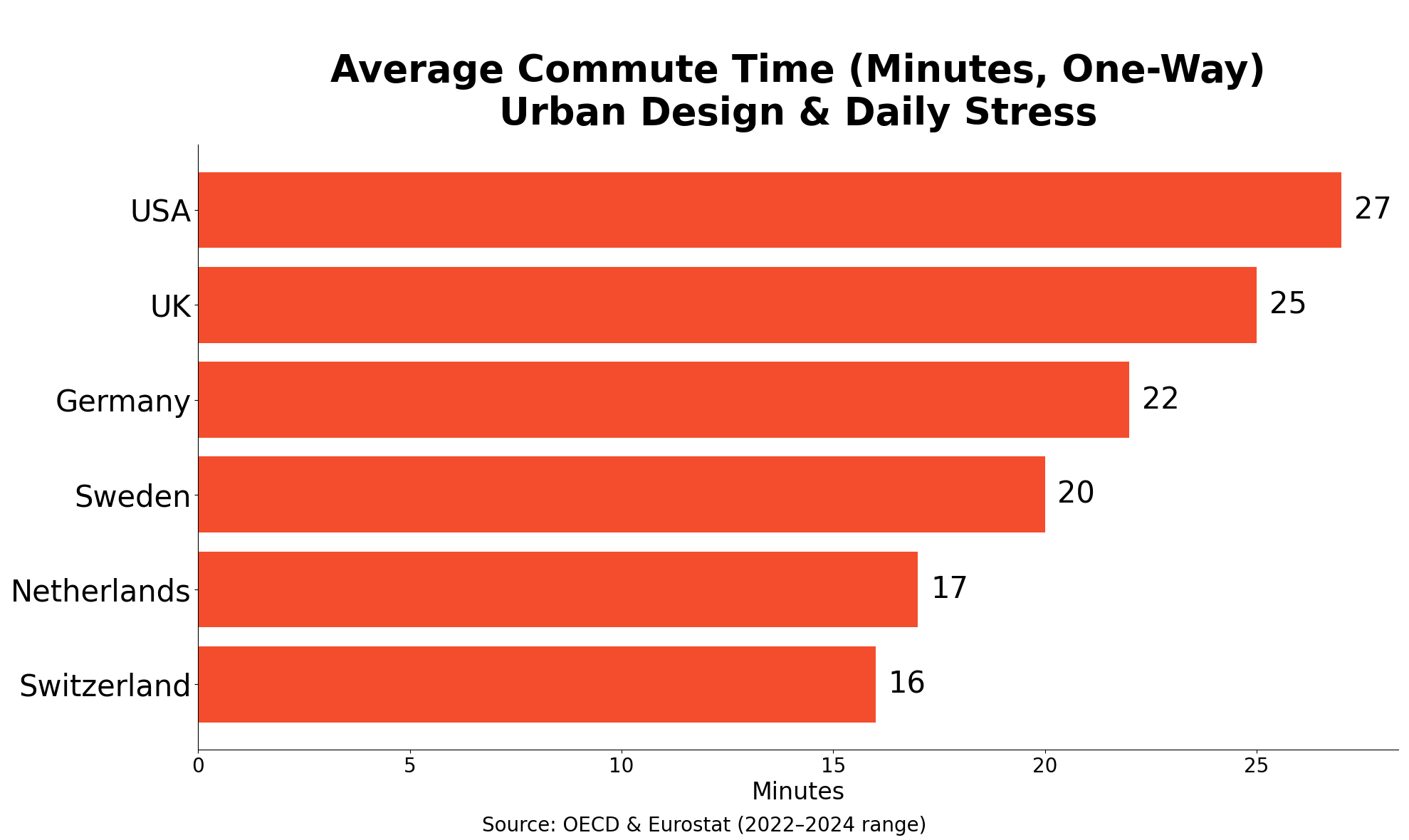
Stress isn’t just national—it’s local. The design of cities plays a powerful role in daily mental load.
🇳🇱 Netherlands cities prioritize biking and walkability, reducing commute stress and improving physical health.
🇸🇪 Stockholm integrates green spaces directly into urban life, ensuring residents are never far from nature.
🇨🇭 Zurich combines efficient public transport with low noise and pollution levels.
These design choices reduce “micro-stressors”—traffic, noise, crowding—that accumulate over time.
A striking statistic: People with commutes longer than 45 minutes report significantly higher daily stress, regardless of income—making city planning a hidden determinant of well-being.
Looking ahead, the countries that reduce stress most effectively may not be the richest—but the most adaptive.
🌍 Remote work is reshaping geography, allowing people to choose calmer environments without sacrificing income.
🧠 Mental health is becoming a policy priority, with governments investing in prevention, not just treatment.
🌱 Sustainability efforts are aligning with well-being, as cleaner environments directly reduce stress.
We’re entering an era where quality of life is measured more holistically—and nations are beginning to compete on well-being, not just output.
Future projection: By 2035, several global indexes are expected to rank countries primarily on “life satisfaction” metrics—potentially reshaping migration and investment patterns worldwide.

Stress may feel inevitable—but as you’ve seen, it’s often designed into (or out of) daily life.
The calmest countries don’t just look peaceful—they remove friction, protect time, and make life feel more manageable day to day.
If you’re thinking about where to live, retire, or invest your future, the takeaway is simple: don’t just follow the money—follow the lifestyle.
Stay curious, stay informed—and keep exploring what a better life could actually look like.
Warm regards,
Shane Fulmer
Founder, WorldPopulationReview.com
P.S. Want to sponsor this newsletter? Reach 143,000+ global-minded readers — click here!