- World Population Review Newsletter
- Posts
- The Hidden Power Behind Global Protests
The Hidden Power Behind Global Protests
Protest data reveals which nations push back—and what it means.

Philip Saparov
February 18, 2026
In partnership with

Greetings, inquisitive mind.
When citizens take to the streets, something deeper is happening. Pressure is building. Trust is shifting. Power is being tested.
Which nations push back the hardest?
Where is dissent a civic norm — and where is it a personal risk?
If you care about stability, opportunity, retirement security, or the future your children inherit, this matters.
Let’s look at the data — and see who dares to challenge authority.
Better prompts. Better AI output.
AI gets smarter when your input is complete. Wispr Flow helps you think out loud and capture full context by voice, then turns that speech into a clean, structured prompt you can paste into ChatGPT, Claude, or any assistant. No more chopping up thoughts into typed paragraphs. Preserve constraints, examples, edge cases, and tone by speaking them once. The result is faster iteration, more precise outputs, and less time re-prompting. Try Wispr Flow for AI or see a 30-second demo.
If there were an Olympic medal for public protest, France would be a perennial contender.
From the French Revolution to the 1968 student uprisings to the recent pension reform protests, civic demonstration is woven into the national fabric. According to global protest databases, France consistently ranks among the highest in Europe for the number of demonstrations per capita.
Three defining features stand out:
Pension reform protests (2023): Millions mobilized nationwide.
The “Yellow Vest” movement: Sparked by fuel taxes, it grew into a broader cost-of-living revolt.
Labor union power: Organized, disciplined, and historically influential.
Yet France remains a high-income, stable democracy with strong social services and healthcare.
Here’s the fascinating twist: surveys show that over half of French citizens believe protest is a legitimate and necessary part of democracy. In France, dissent is civic participation in action.
In the United States, protest culture is both constitutional and cultural.
The First Amendment protects peaceful assembly, and Americans exercise that right frequently. But unlike France’s centralized mobilizations, U.S. protest patterns are highly decentralized—varying by state, issue, and political climate.
Three recent waves define modern American dissent:
Racial justice demonstrations (2020): Among the largest in U.S. history.
Women’s March (2017): Coordinated nationwide activism.
State-level education and healthcare protests: Often locally driven.
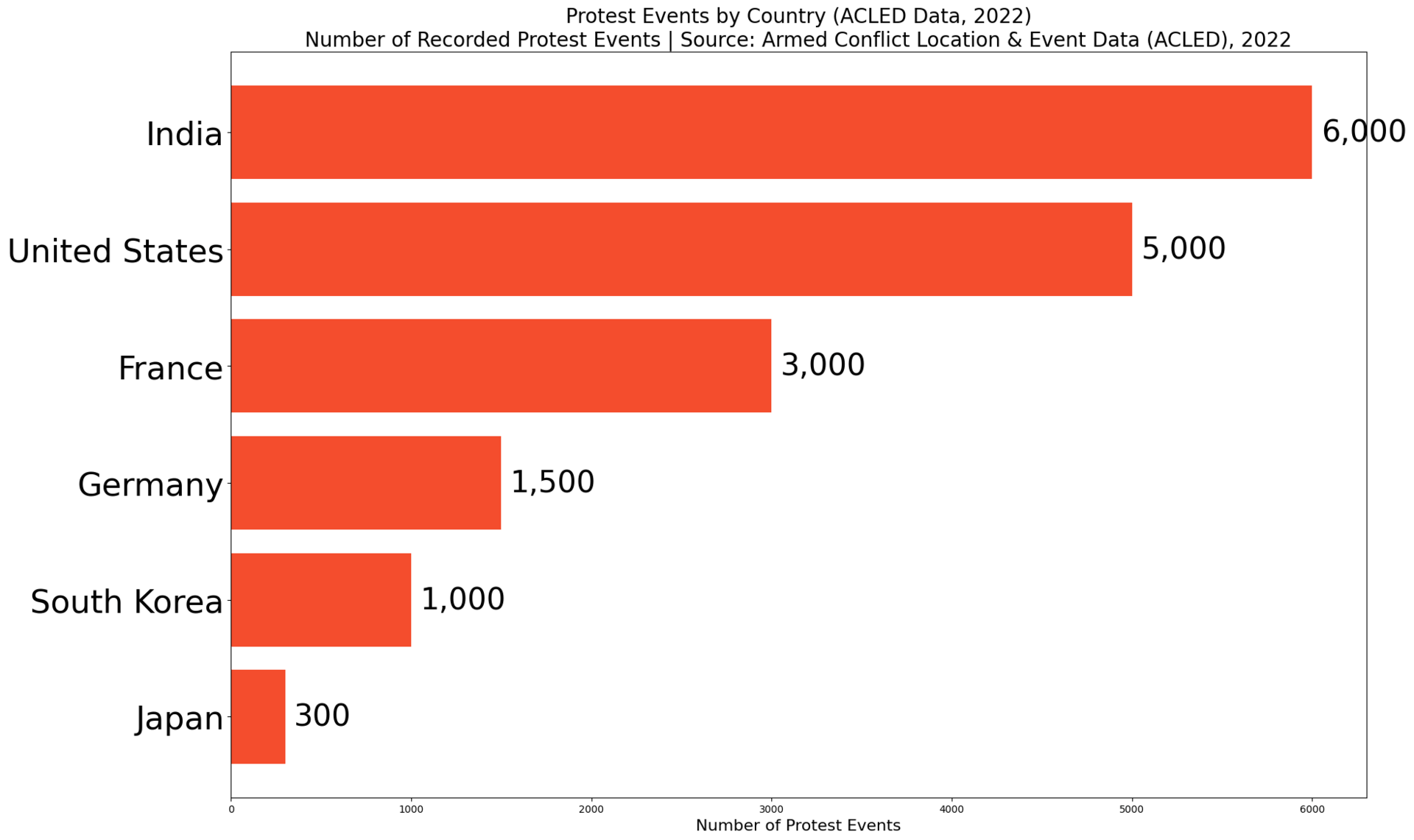
Data from event tracking projects show thousands of protests annually across the country.
For investors or retirees, this raises a key question: does frequent protest signal instability? Historically, markets and institutions in the U.S. have proven resilient—even amid large-scale dissent.
A striking data point: despite high protest volume, the U.S. consistently ranks in the top tier globally for civil liberties protections—a reminder that protest and institutional stability can coexist.

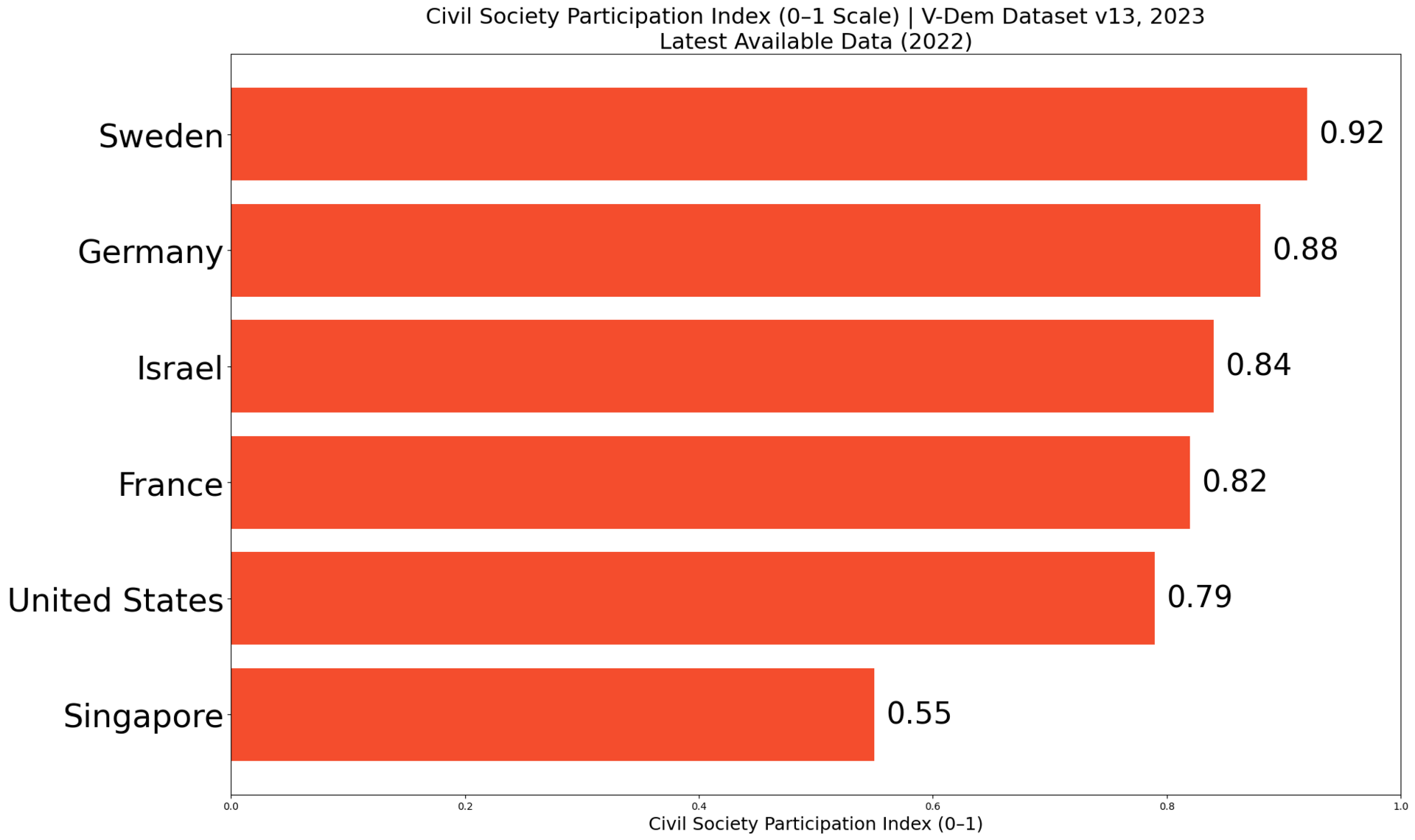
Few democracies experience protest as intensely—and as routinely—as Israel.
In recent years, hundreds of thousands have demonstrated over judicial reforms, cost of living, and security policy. Relative to its population, Israel’s protest participation rates are among the highest in the world.
Three drivers stand out:
Judicial reform debates: Massive weekly demonstrations.
Military service culture: High civic awareness and engagement.
Tight-knit society: Mobilization spreads quickly.
Yet Israel remains a tech powerhouse with strong GDP growth and global investment appeal.
Here’s a telling statistic: at peak moments, protests have drawn more than 5% of the entire population—an extraordinary share by international standards.
For observers, Israel illustrates a paradox: intense civic confrontation paired with economic dynamism.
Learn AI in 5 minutes a day

What’s the secret to staying ahead of the curve in the world of AI? Information. Luckily, you can join 2,000,000+ early adopters reading The Rundown AI — the free newsletter that makes you smarter on AI with just a 5-minute read per day.
South Korea offers one of the clearest examples of protest reshaping power.
In 2016–2017, millions joined candlelight demonstrations demanding accountability from political leadership. The movement remained largely peaceful—and ultimately led to the impeachment of a sitting president through constitutional processes.
Key characteristics:
Mass participation: Estimates reached 16 million cumulative participants.
Peaceful coordination: Internationally noted for order and discipline.
Institutional follow-through: Courts upheld impeachment decisions.
Today, South Korea ranks among the world’s leading democracies and innovation economies.
The remarkable fact? One protest movement not only expressed dissent—it resulted in a constitutional transition of power without military involvement or breakdown of order.
South Korea shows that protest can function as a pressure valve rather than a destabilizer.

When India protests, the numbers are staggering.
As the world’s most populous democracy, even a small percentage of participation translates into millions of voices. The 2020–2021 farmer protests are among the largest sustained demonstrations in modern history.
Three notable elements:
Farmer mobilization: Tens of thousands camped for months near Delhi.
Regional diversity: Movements often vary by state.
Democratic infrastructure: Elections remain robust and competitive.
India experiences frequent public mobilization, yet maintains consistent electoral turnover and economic expansion.
An astonishing perspective: if just 1% of India’s population protests, that’s more than the entire population of many European countries.

Germany may not dominate headlines for protest, but it has a deeply embedded culture of organized civic action.
From environmental movements to anti-nuclear campaigns and climate marches, German protests are typically well-coordinated and peaceful.
Three pillars define its protest landscape:
Strong civil society organizations.
Legal clarity around assembly rights.
High trust in institutions—paired with readiness to mobilize.
Germany consistently ranks high in rule of law and public safety indexes, making it attractive for retirees and investors alike.
Here’s an intriguing insight: Germany sees fewer protests per capita than France—but higher public trust in government institutions. Protest frequency and trust don’t always move in tandem.
Germany shows that structured dissent can coexist with social stability and long-term economic planning.

In some nations, protest carries profound personal risk.
Iran has experienced repeated waves of demonstrations over economic conditions, governance, and social freedoms. Unlike the democracies above, public dissent here often meets severe state response.
Three patterns emerge:
Economic grievances: Inflation and unemployment as catalysts.
Youth participation: A significant driver of mobilization.
Digital coordination: Social media amplifies organization despite restrictions.
Data sources tracking civil unrest consistently place Iran among countries with high protest intensity relative to political freedom constraints.
The sobering statistic: in environments where assembly rights are limited, participation itself can represent extraordinary personal courage.
For global observers, Iran reveals a crucial truth: the willingness to challenge authority is not confined to open societies—but the consequences vary dramatically.

Protest is a signal. It shows where trust is thinning and pressure is building.
If you’re choosing where to invest, retire, or build a future, civic culture matters. Stability creates opportunity.
The strongest societies aren’t those without dissent — but those that turn it into reform.
Stay curious. Read the signals.
Warm regards,
Shane Fulmer
Founder, WorldPopulationReview.com
P.S. Want to sponsor this newsletter? Reach 149,000+ global-minded readers — click here!