- World Population Review Newsletter
- Posts
- The Secret Rail Networks Reshaping the World
The Secret Rail Networks Reshaping the World
How fast trains are transforming power, prosperity, and mobility.

Philip Saparov
November 29, 2025
In partnership with

Greetings, curious navigator of the world in motion!
Airports are clogged. Highways crawl. And yet—on sleek steel rails, a revolution is racing ahead.
High-speed rail is no longer a novelty. It’s a geopolitical play, a climate solution, and a bet on the future. For anyone eyeing where to travel, invest, or relocate—it matters.
Who’s building fastest? Who’s falling behind?
Let’s find out.
The daily health habit you’ll actually stick with…

This time of year, it’s SO hard to stay in control of your health.
Holiday travel (and meals!), big family gatherings, dark and cold days, it’s easy to skip that workout, sleep in later than you should, or have just one more cookie.
That’s why you need a daily health habit that’s easy to stick with.
Meet AG1: With just one quick scoop every morning, you’ll get over 75 ingredients that help support your immune health, gut health, energy, and close nutrient gaps in your diet.
Right now is the best time to get started - with every new subscription, they are giving away $126 in free gifts for the holidays.
Give AG1 a try today and take control of your health this holiday season.
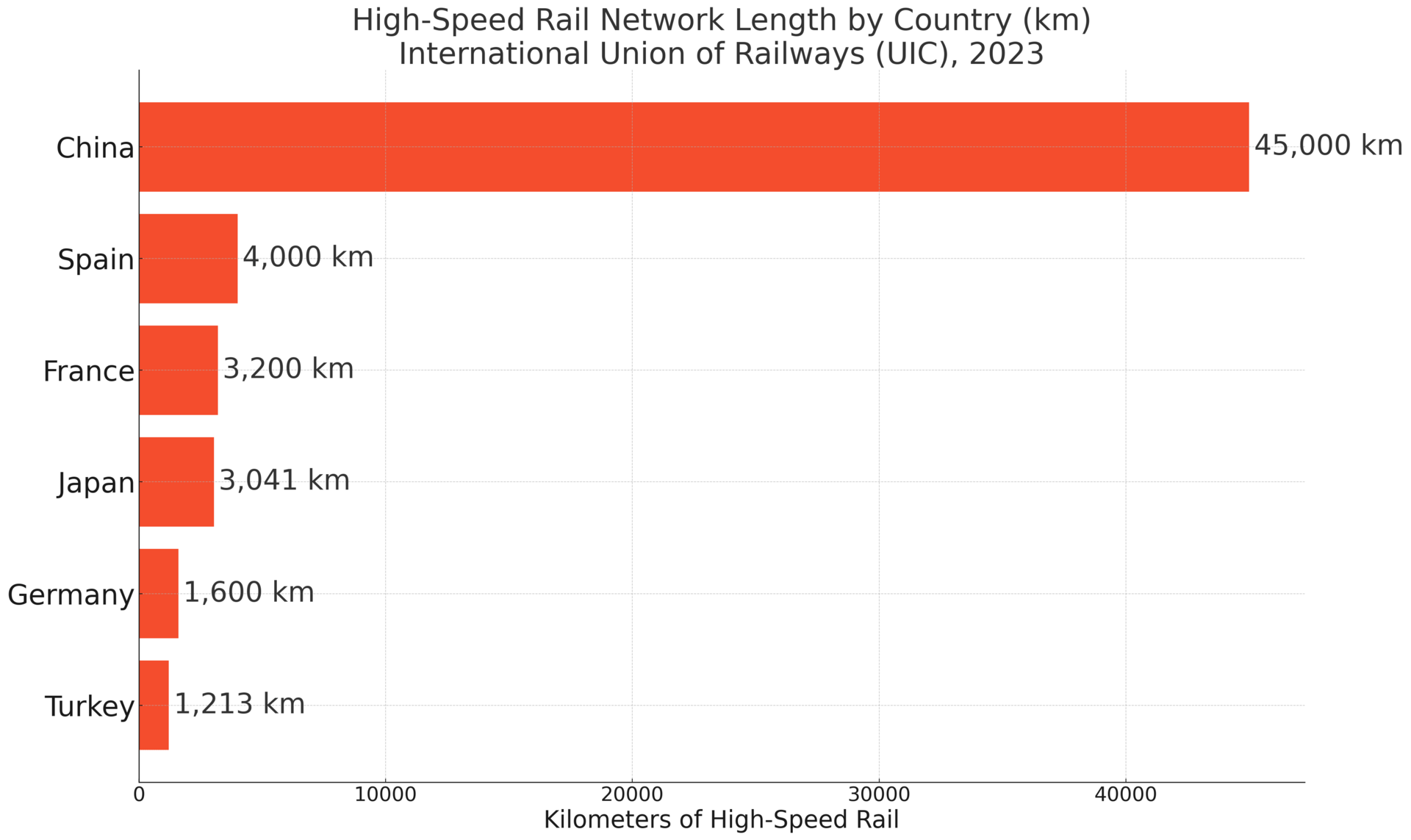
If high-speed rail were an Olympic event, China would have retired the gold medal by now.
With over 45,000 km (28,000+ miles) of high-speed lines—more than the rest of the world combined—China’s investment in rail is as much geopolitical as it is practical. It’s not just about moving people; it’s about unifying a nation and extending influence.
Beijing to Shanghai? Five hours. Zhengzhou to Shenzhen? Six. These are city pairs that once required overnight trains—or flights.
China’s top performers:
🚄 Beijing-Shanghai: Handles more passengers than any other high-speed rail line on Earth.
🛤 The Fuxing trains: Domestically developed, reaching speeds of 350 km/h (217 mph).
🌐 Belt & Road HSR exports: China is building or funding rail systems in Laos, Indonesia, and even Eastern Europe.
Fascinating stat: A 2023 study found that every 1,000 km of HSR track built in China boosts regional GDP by 2.6% within five years.
Japan may have launched the modern HSR era with the Shinkansen in 1964, but it’s not resting on nostalgia.
The country continues to set global standards for safety, punctuality, and engineering precision. Trains depart every 3 minutes on some routes—and arrive on time within seconds.
What’s new on Japan’s rails:
🧪 Maglev marvels: The Chuo Shinkansen, now under construction, will use magnetic levitation to fly passengers from Tokyo to Nagoya in just 40 minutes.
🔄 Aging gracefully: Older lines are being retrofitted with advanced tech to reduce energy consumption.
📉 Population strategy: With a shrinking population, HSR is being recalibrated to support regional revitalization efforts.
Unexpected fact: Despite its age, the Tokaido Shinkansen still carries over 400,000 passengers daily—with zero fatalities in over 50 years.

It may surprise some, but Saudi Arabia has launched one of the most futuristic high-speed rail projects in the Middle East.
The Haramain High-Speed Railway, completed in 2018, connects the holy cities of Mecca and Medina, slicing a formerly 4-hour journey down to 2 hours.
Key developments:
🕌 Haramain HSR: Built for both pilgrimage and modernization, this line moves over 60 million passengers a year.
🌟 NEOM ambitions: Saudi’s smart city project includes a 170 km urban rail corridor, blending AI, green energy, and mobility into one.
🔋 Sustainability push: The country is investing in electric trains and solar-powered stations.
Insight to remember: This isn’t just a transportation project—it’s a symbolic leap toward Saudi’s Vision 2030: a pivot from oil to innovation.
3 Tricks Billionaires Use to Help Protect Wealth Through Shaky Markets

“If I hear bad news about the stock market one more time, I’m gonna be sick.”
We get it. Investors are rattled, costs keep rising, and the world keeps getting weirder.
So, who’s better at handling their money than the uber-rich?
Have 3 long-term investing tips UBS (Swiss bank) shared for shaky times:
Hold extra cash for expenses and buying cheap if markets fall.
Diversify outside stocks (Gold, real estate, etc.).
Hold a slice of wealth in alternatives that tend not to move with equities.
The catch? Most alternatives aren’t open to everyday investors
That’s why Masterworks exists: 70,000+ members invest in shares of something that’s appreciated more overall than the S&P 500 over 30 years without moving in lockstep with it.*
Contemporary and post war art by legends like Banksy, Basquiat, and more.
Sounds crazy, but it’s real. One way to help reclaim control this week:
*Past performance is not indicative of future returns. Investing involves risk. Reg A disclosures: masterworks.com/cd
Europe isn’t just riding the wave—it helped start it. And while each country charts its own path, the EU is pushing toward a unified high-speed rail network that could one day rival air travel.
🇫🇷 France: The iconic TGV now connects over 230 cities and recently launched low-carbon hydrogen train trials.
🇩🇪 Germany: While slower to adopt HSR, Germany’s ICE trains now link major cities like Berlin, Munich, and Frankfurt—and will soon expand toward Denmark and the Czech Republic.
🇪🇸 Spain: Spain has the longest HSR network in Europe and some of the most affordable ticket prices, thanks to deregulation and competition.
Did you know? Spain now offers high-speed train tickets starting at €7, making it one of the most accessible systems in the world.

America is finally trying to catch the high-speed train—literally.
After decades of dreaming, the California High-Speed Rail project is finally under construction. If completed, it would link Los Angeles and San Francisco in under 3 hours. Meanwhile, private players are stepping in to speed things along.
Top stories:
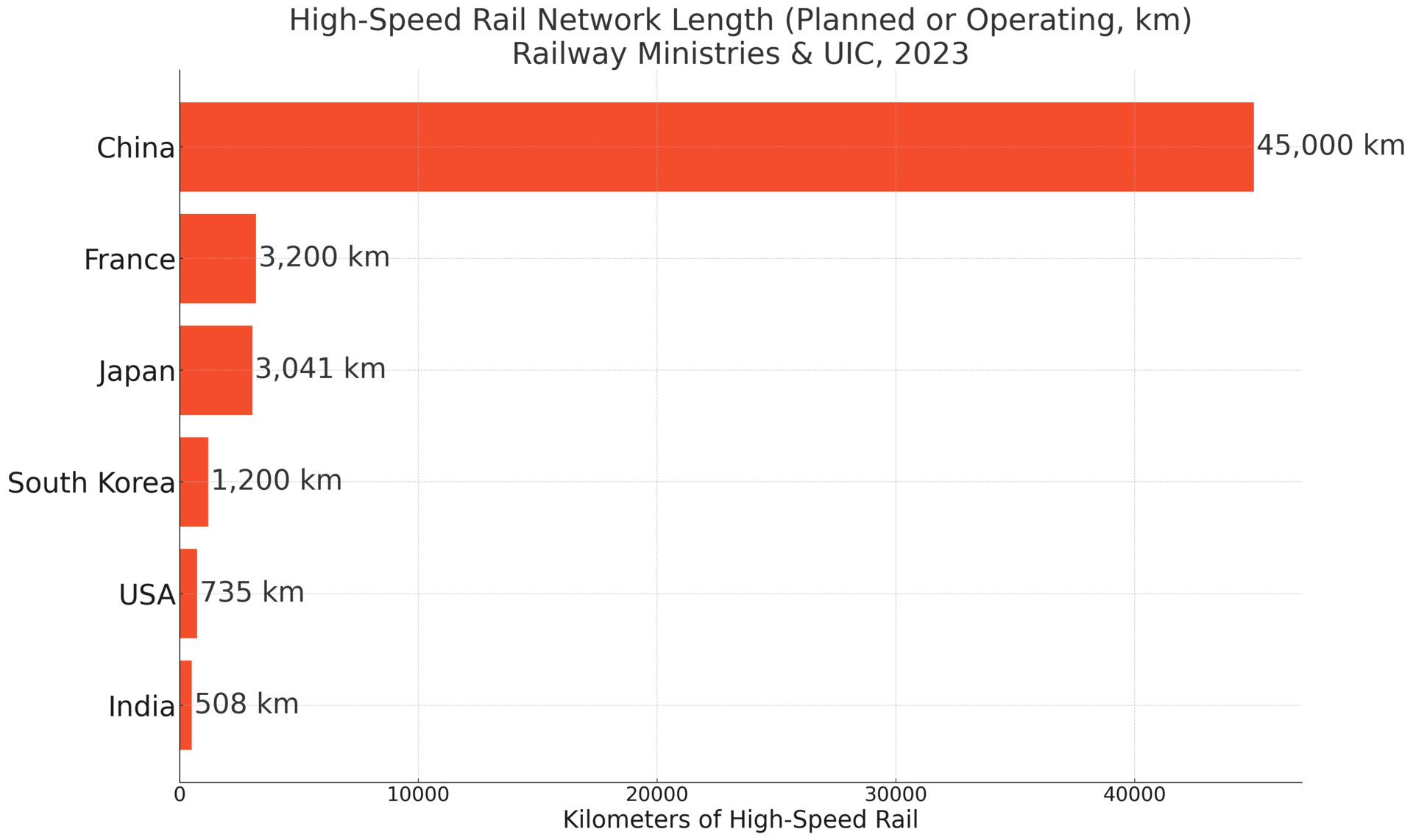
🚧 California HSR: 119 miles under construction, but timelines stretch into the 2030s.
🚄 Brightline (Florida & Las Vegas): The first true private HSR in the U.S., now running between Miami and Orlando, with Las Vegas–LA in the works.
💰 Federal push: The Biden administration has allocated $66 billion for passenger rail upgrades.
Eye-opener: The U.S. currently has only one train (Acela) that qualifies as “high-speed”—and only barely.

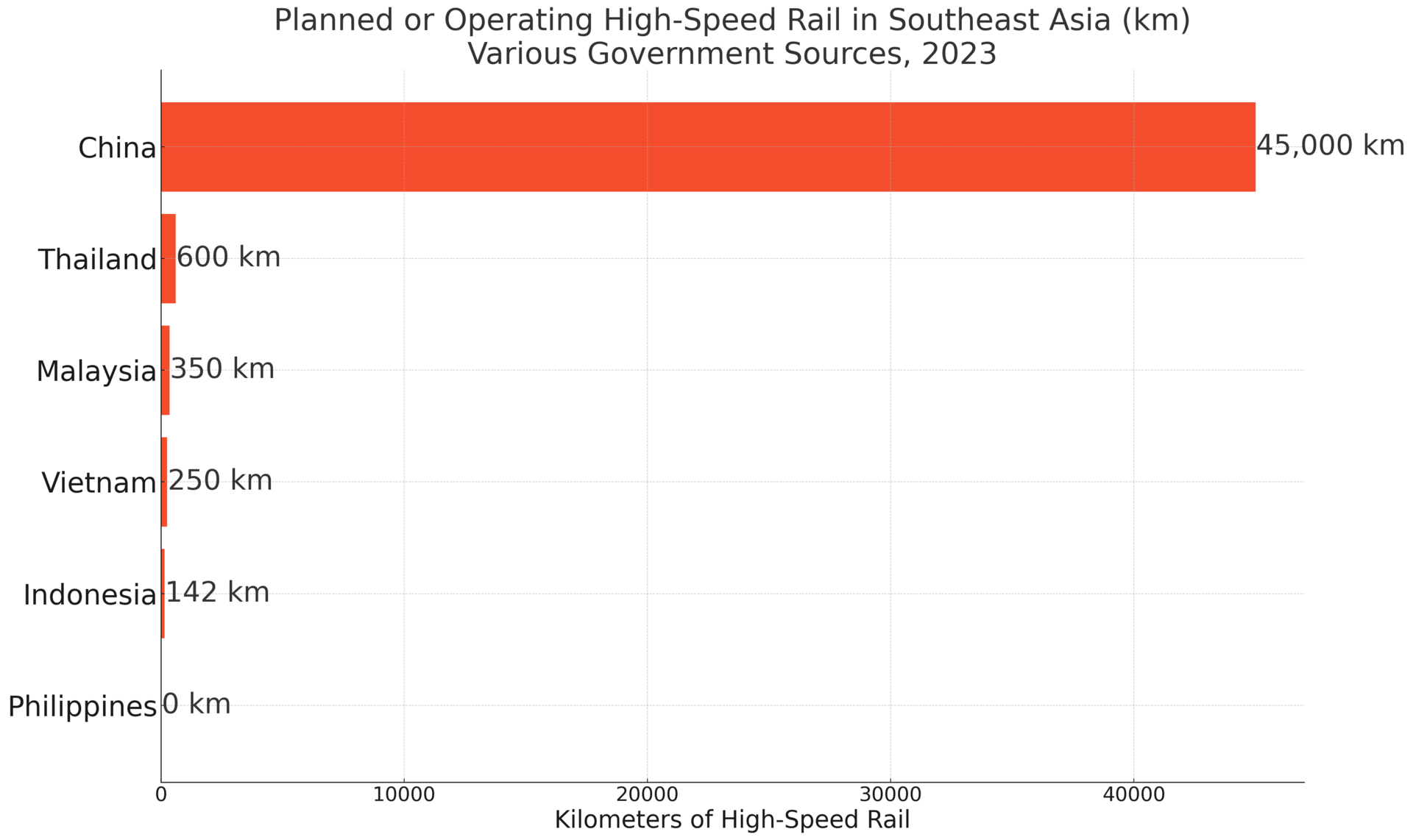
Southeast Asia is turning into a high-speed laboratory—with China, Japan, and local governments racing to lay track and win influence.
🚄 Indonesia: With Chinese funding, Indonesia launched Southeast Asia’s first bullet train, the Jakarta–Bandung line, in 2023.
🧭 Thailand: The Thai government is building a 600 km HSR line from Bangkok to Nong Khai, potentially connecting to Laos and China.
🇲🇾 Malaysia–Singapore link: After years of delays, talks have resumed on the high-speed corridor that could connect Kuala Lumpur to Singapore in just 90 minutes.
Trend to watch: Whoever builds the tracks often shapes the policy—and the politics. Infrastructure is becoming a new kind of diplomacy.
In the graph below, “planned or operating” includes high-speed rail lines that are either already in service or under active construction with secured government backing.
With its vast population and chronic rail congestion, India is a natural candidate for HSR. Now, it’s finally laying down the steel.
The first high-speed corridor between Mumbai and Ahmedabad—built with Japanese support—is expected to launch in 2026, slashing travel time from 8 hours to 3.
In motion:
🔨 Construction underway: 508 km of track, including India’s first undersea rail tunnel.
🤝 Japan–India partnership: Japan is providing both technology and financing, exporting its Shinkansen model.
🌆 Urban impact: HSR could radically reshape real estate and economic clusters between major cities.
One to remember: India’s railways already carry 23 million people a day—more than Australia’s entire population. Even modest HSR expansion could transform the nation.
In the graph below, “planned or operating” reflects corridors currently in use or officially under construction with committed funding.
Steel rails are silently redrawing the world’s future—not just how we travel, but how we live, invest, and grow.
These trains are signals of momentum, prosperity, and what's coming next.
Stay sharp. Stay mobile. The world is moving fast.
Warm regards,
Shane Fulmer
Founder, WorldPopulationReview.com
P.S. Want to sponsor this newsletter? Reach 139,000+ global-minded readers — click here!