- World Population Review Newsletter
- Posts
- Why Wildlife Is Moving Closer to You
Why Wildlife Is Moving Closer to You
Where humans and wildlife now overlap most—and why it matters.

Philip Saparov
February 20, 2026
In partnership with

Greetings, curious observer.
Imagine stepping outside your home — and sharing the edge of it with the wild.
Across the globe, people and wildlife are moving closer together. Not by accident — but by expansion, density, and necessity.
Where that overlap grows, so do the stakes. If you’re choosing where to live, invest, or retire, this matters.
Let’s see where the boundaries are disappearing.
You're overpaying for crypto.

Every exchange has different prices for the same crypto. Most people stick with one and pay whatever it costs.
CoW Swap checks them all automatically. Finds the best price. Executes your trade. Takes 30 seconds.
Stop leaving money on the table.
India hosts nearly 1.4 billion people — alongside tigers, elephants, leopards, and one of the world’s largest livestock populations.
With dense rural settlement and fragmented habitats, human–animal encounters are frequent. Elephant migration corridors often intersect with farmland. Leopard sightings near cities such as Mumbai have increased as development expands outward.
Three drivers stand out:
Rapid population growth near forest edges
Agricultural expansion into wildlife corridors
Protected areas bordered by villages
India reports hundreds of human fatalities annually from elephant encounters alone.
A striking detail: more than 60% of India’s protected wildlife areas are surrounded by human settlements within just a few kilometers — creating one of the world’s most concentrated wildlife overlap zones.

In Kenya, wildlife tourism and pastoral livelihoods coexist on the same landscape.
Large mammals — lions, elephants, buffalo — often roam outside national parks. Many rural communities depend on livestock grazing in open lands that double as migration routes.
Key patterns:
Expanding settlements near conservation areas
Climate-driven drought pushing animals toward villages
Increased livestock predation
Kenya records some of the highest rates of livestock loss due to large predators in Africa.
Yet over 65% of wildlife lives outside formally protected parks — meaning human coexistence is not the exception, but the norm.
For landowners or investors, this creates both opportunity (eco-tourism, conservation partnerships) and measurable risk.

In Brazil, especially along the Amazon basin, human settlement continues to move deeper into forested regions.
Deforestation has created fragmented habitat patches, bringing ranchers, small farmers, and wildlife into closer contact.
Relevant dynamics:
Cattle ranching expansion
Road construction through forest
Encounters with jaguars, snakes, and disease vectors
Brazil reports thousands of snakebite cases annually, many in newly developed frontier areas.
An important statistic: satellite analysis shows that in some Amazon regions, forest loss has reduced buffer zones between settlements and primary habitat to less than five kilometers — dramatically narrowing the separation between people and wildlife.

Stop typing prompt essays

Dictate full-context prompts and paste clean, structured input into ChatGPT or Claude. Wispr Flow preserves your nuance so AI gives better answers the first time. Try Wispr Flow for AI.
In the United States, overlap is rising not in remote jungles — but in suburbs.
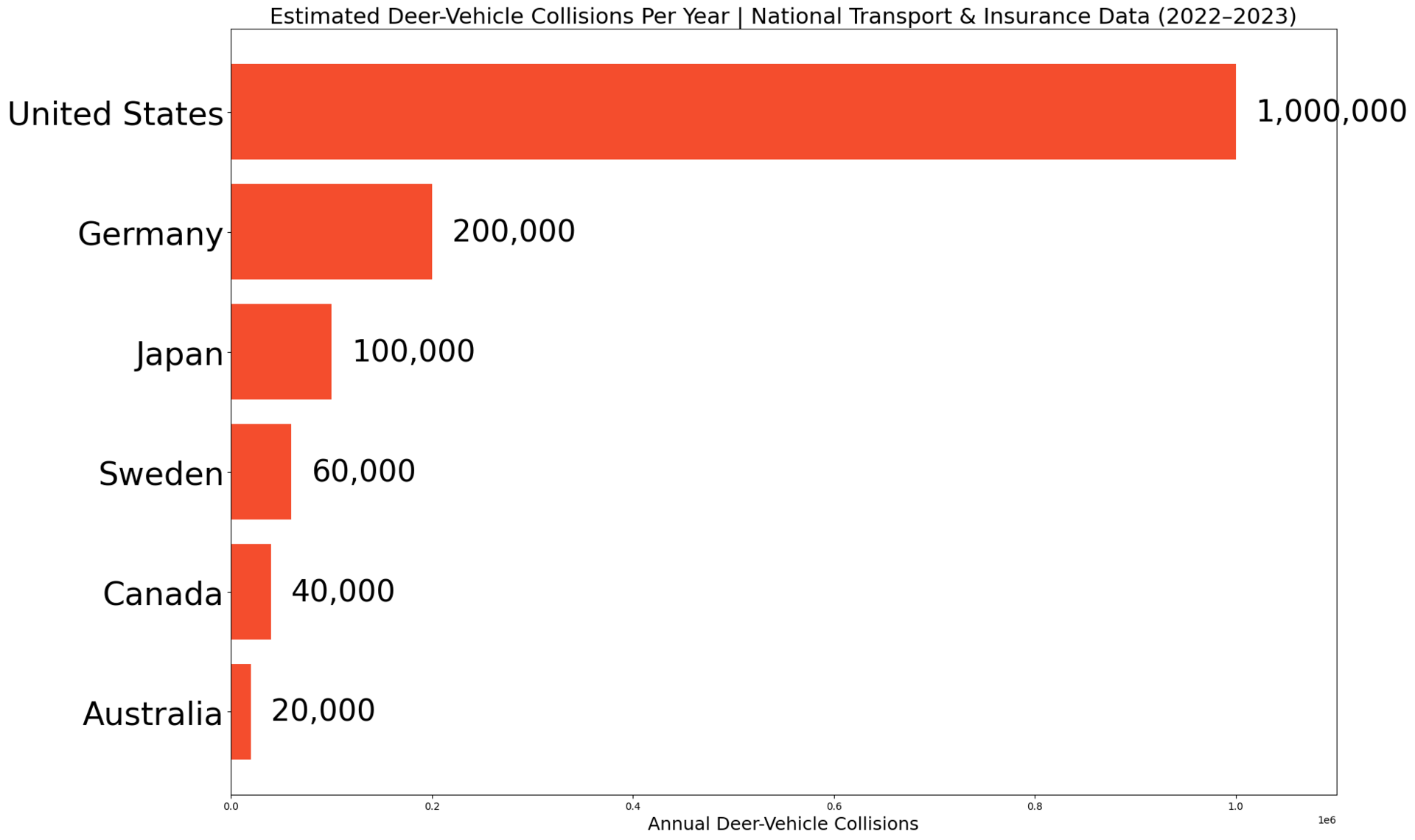
White-tailed deer populations are at historic highs. Black bears increasingly enter residential areas in states like Colorado and North Carolina. Coyotes now inhabit nearly every major metropolitan area.
Driving factors include:
Reforestation in the eastern U.S.
Predator decline
Expanding suburban housing near woodland
Deer-vehicle collisions now number over one million annually.
The unexpected insight: some of the highest wildlife encounter rates occur not in wilderness states — but in densely populated suburban corridors.
Nepal is a conservation success story — and a human–wildlife overlap hotspot.
Tiger and rhino populations have rebounded significantly in recent decades. But many protected areas are bordered by farming communities.
Recent data shows:
Rising tiger density in certain parks
Increased livestock attacks
Occasional human fatalities in buffer zones
More than 40% of Nepal’s land is under forest cover, yet millions depend on subsistence agriculture nearby.
A revealing fact: Nepal doubled its tiger population within 12 years — a rare global conservation outcome — but conflict incidents have risen proportionally in some districts.

Australia’s wildlife overlap includes both iconic and hazardous species.
Urban sprawl in cities like Brisbane has expanded into bushland inhabited by kangaroos and snakes. In northern regions, saltwater crocodiles inhabit waterways near residential areas.
Key factors:
Housing development along coastlines
Climate shifts altering animal ranges
Fire-driven habitat displacement
Australia reports thousands of venomous snakebite incidents annually — though fatalities remain low due to rapid medical access.
The pattern is clear: even highly developed countries face growing interaction where housing pushes into native habitat.

Germany presents a different story: wildlife returning to human-dominated landscapes.
Wolves, once absent, have re-established breeding populations across several states. Wild boar numbers have surged near cities.
Important developments:
Legal protection of large predators
Expanding forest cover
Livestock predation concerns
Wild boar now cause hundreds of millions of euros in agricultural damage annually.
The broader insight: overlap doesn’t require tropical forests. It can occur wherever ecosystems regenerate faster than settlement patterns adapt.

Living near wildlife can mean beauty.
It can also mean risk.
This isn’t limited to remote forests or developing regions. The overlap is global — and growing.
If you’re evaluating property, land, or long-term settlement, proximity to wildlife isn’t a romance factor. It’s a variable.
Watch the edges, because where people and wildlife meet, pressure builds first.
Warm regards,
Shane Fulmer
Founder, WorldPopulationReview.com
P.S. Want to sponsor this newsletter? Reach 142,000+ global-minded readers — click here!